AI Startups in Healthcare

Artificial Intelligence (AI) is transforming the healthcare industry in ways that were unimaginable a few years ago. From early disease detection to drug discovery and hospital management, AI is helping healthcare become faster, more accurate, and more efficient. Because of these opportunities, many AI startups are entering the healthcare industry with innovative solutions. These startups are not only improving patient care but also creating new business models and changing how healthcare services are delivered.
AI startups in healthcare are companies that use artificial intelligence technologies such as machine learning, deep learning, natural language processing, and computer vision to solve healthcare problems. These startups develop software and platforms that can analyze medical data, detect diseases, manage hospital operations, and help doctors make better decisions. The goal of most healthcare AI startups is to reduce healthcare costs, improve diagnosis accuracy, and make healthcare services more accessible.
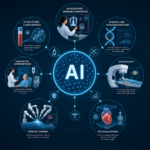
One of the biggest areas where AI startups are working is disease detection and diagnosis. AI systems can analyze medical images such as X-rays, MRI scans, and CT scans to detect diseases like cancer, brain tumors, lung infections, and heart problems. In many cases, AI can detect diseases earlier than traditional methods because it can analyze large amounts of data quickly and identify patterns that humans may not easily notice. This helps doctors start treatment earlier and improve patient outcomes.
Another important area is drug discovery. Developing new medicines is a very expensive and time-consuming process. AI startups are using artificial intelligence to analyze biological data and predict which chemical compounds can be used to create new medicines. This reduces the time required for drug development and also reduces costs for pharmaceutical companies.
AI startups are also working on hospital management systems. Hospitals generate a large amount of data every day, including patient records, billing information, staff schedules, and inventory management. AI systems can analyze this data and help hospitals improve efficiency, reduce waiting time, and manage resources better. For example, AI can predict how many patients are likely to visit the hospital on a particular day and help hospitals prepare staff and equipment accordingly.
Remote patient monitoring is another area where AI startups are growing rapidly. Wearable devices such as smartwatches and health monitoring devices collect data such as heart rate, oxygen level, blood pressure, and sleep patterns. AI systems analyze this data and alert doctors if there is any health risk. This is very useful for patients with chronic diseases such as diabetes, heart disease, and hypertension.
AI startups are also developing chatbots and virtual health assistants that can answer patient questions, schedule appointments, remind patients to take medicines, and provide basic medical advice. These chatbots reduce the workload of hospital staff and improve patient engagement.
The business model of AI healthcare startups usually depends on software and data. Many AI startups provide Software-as-a-Service (SaaS) platforms to hospitals and clinics. Healthcare organizations pay a monthly or yearly subscription fee to use AI software. Some startups also earn money by licensing their AI technology to hospitals, diagnostic centers, and pharmaceutical companies. Others partner with insurance companies and healthcare providers to provide AI-based healthcare solutions.
AI startups in healthcare have many advantages as a business. First, the demand for healthcare services is always high, which means there is always a market for healthcare solutions. Second, AI technology can solve real problems such as disease detection, hospital management, and patient monitoring. Third, AI software can be scaled easily, meaning the same software can be used by many hospitals and clinics without much additional cost.
However, AI healthcare startups also face several challenges. One major challenge is data privacy and security because medical data is very sensitive. Another challenge is government regulations because healthcare is a highly regulated industry. AI startups must ensure that their technology is safe and accurate before it can be used in hospitals. AI systems also require large amounts of medical data for training, which can be difficult to obtain.
Despite these challenges, the future of AI startups in healthcare is very bright. In the coming years, AI will be used for personalized medicine, robotic surgery, disease prediction, and smart hospitals. AI will not replace doctors, but it will help doctors make better decisions and provide better treatment to patients.