Generative Biology: Designing Drugs Without Traditional Labs
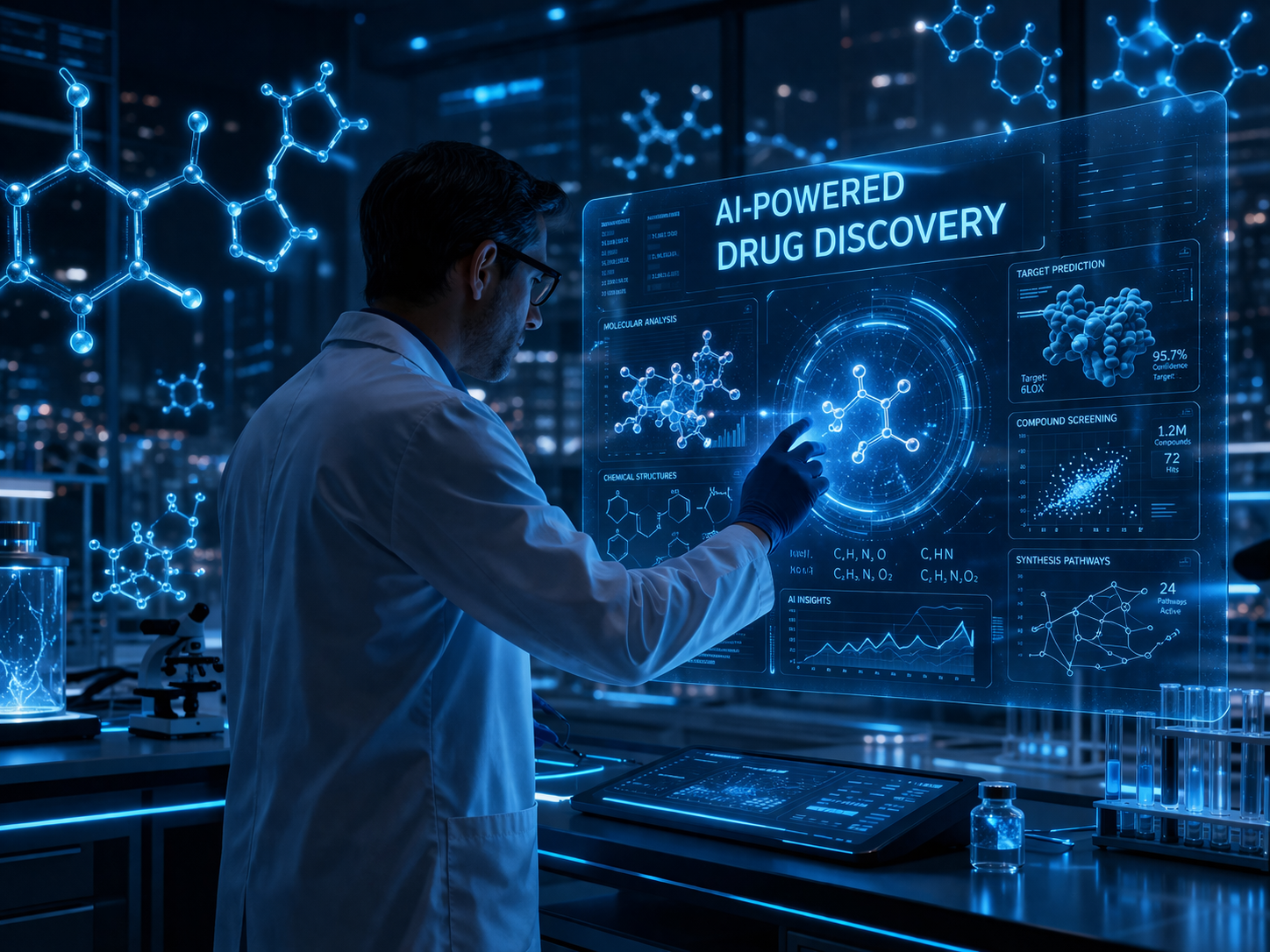
For over a century, drug discovery has followed a familiar path—identify a biological target, screen thousands of compounds in physical labs, test promising candidates, and gradually refine them through years of experimentation. It’s a process defined by trial and error, high costs, and long timelines. But a new paradigm is emerging, one that challenges the very foundation of how medicines are created: generative biology.
At its core, generative biology applies artificial intelligence—particularly generative models—to design biological molecules, proteins, and drugs digitally before they are ever synthesized in a lab. Instead of testing millions of compounds physically, researchers can now simulate, predict, and generate potential therapies in silico, dramatically accelerating the pace of discovery.
This shift is not just an incremental improvement. It represents a fundamental rethinking of the drug development pipeline.
Traditionally, drug discovery begins with screening—scientists expose biological targets to vast libraries of molecules, hoping to find a match that produces the desired effect. Even with automation, this approach is resource-intensive and inefficient. Generative biology flips this model. Instead of searching blindly, AI systems design molecules with specific properties from the start.
These models are trained on massive datasets of biological structures, chemical interactions, and experimental outcomes. Over time, they learn the “language” of biology—how proteins fold, how molecules bind, and how subtle changes in structure can alter function. With this knowledge, they can generate entirely new compounds tailored to a specific target or disease.
Imagine needing a molecule that binds to a protein involved in cancer progression. Instead of screening existing compounds, a generative model can propose novel molecular structures predicted to interact with that protein in precise ways. These candidates can then be ranked, refined, and validated digitally before moving to physical testing.
The implications for speed are profound. What once took years of iterative lab work can now be compressed into months or even weeks. Researchers can explore a vastly larger design space, testing ideas virtually that would be impractical or impossible in traditional settings.
Cost is another major factor. Drug development is notoriously expensive, often exceeding billions of dollars per successful therapy. A significant portion of this cost comes from failed experiments and late-stage attrition. By improving the quality of candidates early in the process, generative biology can reduce the number of failures downstream, making the entire pipeline more efficient.
But perhaps the most exciting aspect of generative biology is its ability to explore the unknown. Traditional methods are limited by existing libraries and human intuition. AI, on the other hand, can generate entirely novel molecular structures—designs that have never existed before. This opens the door to new classes of drugs and therapies that might otherwise remain undiscovered.
The impact extends beyond small-molecule drugs. Generative biology is being applied to protein engineering, antibody design, and even synthetic biology. Researchers can design enzymes with specific functions, optimize antibodies for better targeting, or create biological systems that perform entirely new tasks.
In infectious disease, for example, generative models can rapidly design antiviral compounds or vaccine candidates in response to emerging pathogens. During outbreaks, this speed could be critical, enabling faster responses and potentially saving lives.
In rare diseases, where traditional drug development is often economically unviable, generative biology offers a new path forward. By reducing costs and timelines, it becomes more feasible to develop targeted therapies for smaller patient populations.
Despite its promise, generative biology is not a complete replacement for traditional labs—at least not yet. Physical validation remains essential. Predictions made by AI must be tested in real biological systems to confirm their safety and efficacy. However, the role of the lab is changing. Instead of being the primary engine of discovery, it becomes a validation layer for ideas generated digitally.
This shift also introduces new challenges. One of the most significant is data quality. Generative models are only as good as the data they are trained on. Incomplete, biased, or noisy datasets can lead to inaccurate predictions. Ensuring high-quality, diverse data is critical to the success of these systems.
Another challenge is interpretability. Scientists need to understand why a model suggests a particular molecule or design. Black-box systems can limit trust and hinder adoption, especially in a field where decisions have significant consequences.
Regulatory frameworks must also evolve. Drug approval processes are built around traditional development methods. As AI-designed drugs become more common, regulators will need to adapt to evaluate these new approaches while maintaining rigorous safety standards.
There are also ethical considerations. The ability to design biological systems raises questions about misuse, dual-use risks, and the broader implications of manipulating life at a molecular level. Governance and oversight will play a crucial role in ensuring that generative biology is used responsibly.
Despite these challenges, momentum is building rapidly. Advances in computational power, machine learning algorithms, and structural biology are converging to make generative biology increasingly viable. Companies and research institutions are already reporting early successes, with AI-designed molecules entering preclinical and clinical stages.
Looking ahead, the integration of generative biology with other technologies could amplify its impact. Combining it with high-throughput automation, robotics, and real-time data feedback loops could create a fully integrated discovery pipeline—where design, testing, and refinement happen in a continuous cycle.
The long-term vision is compelling: a future where drug discovery is faster, more precise, and more accessible. A future where therapies can be designed on demand, tailored to individual patients or specific disease profiles.
In that future, the role of the scientist does not disappear—it evolves. Researchers become designers and orchestrators, guiding AI systems, interpreting results, and ensuring that innovation aligns with human needs and values.
Generative biology is not about eliminating the lab. It is about redefining its role.
Instead of being the starting point, the lab becomes the proving ground for ideas born in silicon. And as this transformation unfolds, it has the potential to reshape not just how we develop drugs, but how we understand and interact with biology itself.