Quantum Computing Will Play a Major Role in Healthcare
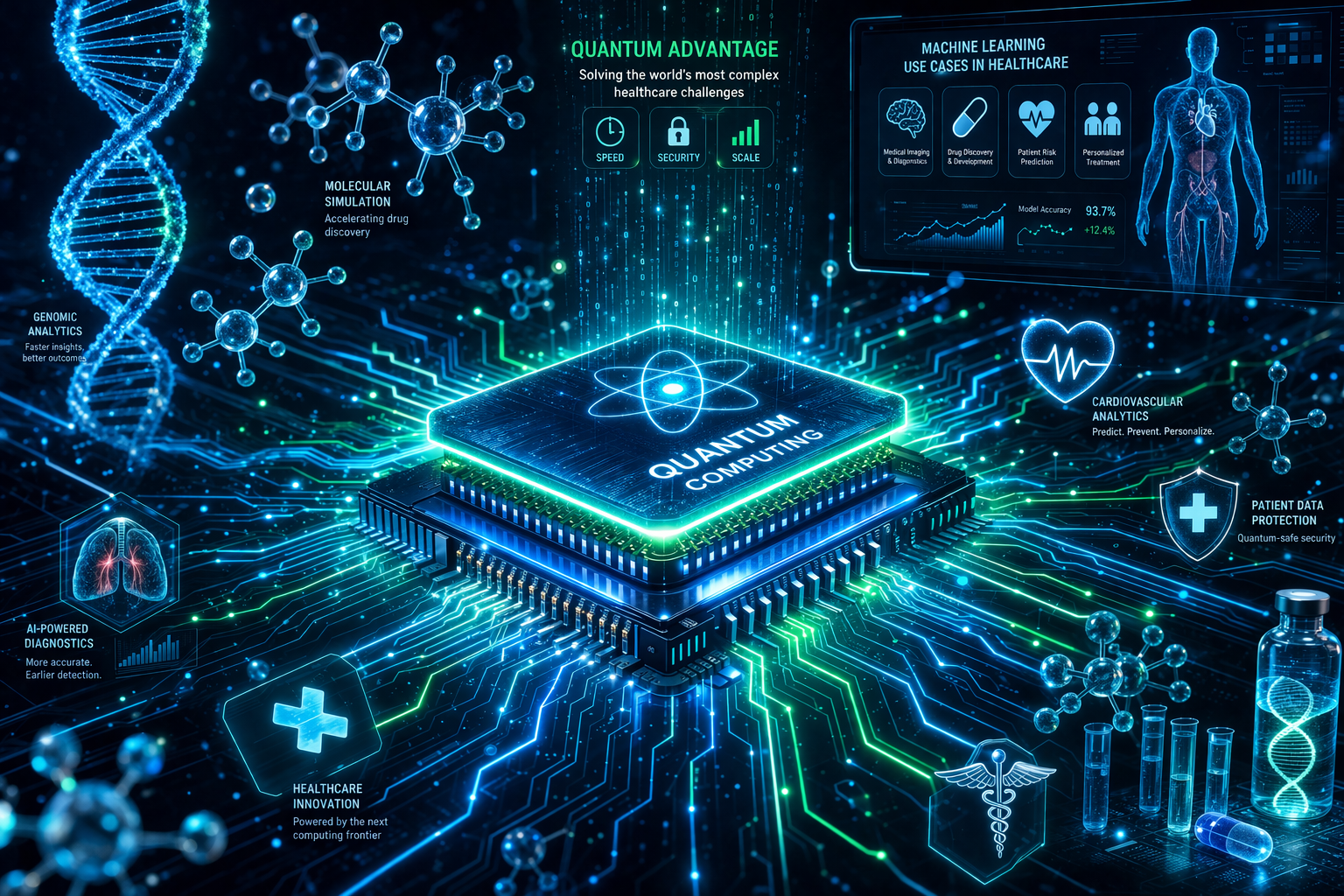
Quantum computing is expected to become one of the most important technologies in the future of healthcare. While technologies like artificial intelligence, cloud computing, and big data are already transforming hospitals and medical research, quantum computing has the potential to solve some of the most complex problems in medicine that traditional computers cannot solve efficiently. Although quantum computing is still in the early stages, researchers, pharmaceutical companies, and healthcare organizations are already exploring how it can be used to improve drug discovery, disease prediction, genomics, and healthcare operations.
Healthcare is a highly complex field because it involves biological systems, chemical reactions, genetic structures, and large-scale data analysis. Traditional computers process information in bits, which can be either 0 or 1. Quantum computers use qubits, which can exist as both 0 and 1 at the same time due to a concept called superposition. Quantum computers also use entanglement, which allows qubits to work together in ways that dramatically increase computing power. Because of this, quantum computers can process extremely complex calculations much faster than traditional computers.
One of the biggest areas where quantum computing will play a major role is drug discovery. Developing new medicines is a very long and expensive process. It often takes more than ten years and billions of dollars to develop a single drug. The main reason for this is that scientists must test thousands of chemical combinations to find a compound that works safely and effectively. These chemical reactions and molecular interactions are very complex and difficult to simulate using traditional computers. Quantum computers can simulate molecular structures and chemical reactions much more accurately and quickly. This means scientists can test potential drugs virtually before testing them in laboratories, which can significantly reduce the time and cost required to develop new medicines. In the future, this could help in developing treatments for diseases such as cancer, Alzheimer’s disease, and rare genetic disorders much faster than today.
Another important area is genomics and personalized medicine. Every person has a unique genetic structure, and many diseases are related to genetic mutations. Personalized medicine is a concept where treatments are designed specifically for an individual based on their genetic makeup. However, analyzing DNA data is very complex because the human genome contains billions of data points. Traditional computers take a long time to process this data. Quantum computing can analyze genetic data much faster, helping doctors identify disease risks early and create personalized treatment plans. This could lead to more accurate treatments and better patient outcomes.
Quantum computing can also help researchers understand complex diseases. Many diseases are related to protein folding, virus behavior, and biological interactions inside the human body. These processes are extremely complex and involve many variables, making them difficult to simulate using traditional computers. Quantum computing can simulate biological systems more accurately, which can help scientists understand how diseases develop and how they can be treated. This could lead to major breakthroughs in medical research.
In addition to research and drug development, quantum computing may also help improve hospital operations. Hospitals are very complex systems that must manage patient scheduling, staff allocation, emergency services, supply chains, and resource management. These are optimization problems, and quantum computing is very good at solving optimization problems. In the future, quantum computing could help hospitals reduce waiting times, improve patient scheduling, optimize ambulance routes, and manage hospital resources more efficiently. This can improve patient care and reduce operational costs.
Quantum computing is also expected to work together with artificial intelligence in healthcare. Artificial intelligence is very good at analyzing data and identifying patterns, while quantum computing provides extremely high processing power. When combined, these technologies can be used for disease prediction, medical imaging analysis, drug discovery, and clinical decision support. This combination could lead to faster and more accurate medical decisions.
However, quantum computing is still developing and is not yet widely used in hospitals. Quantum computers are expensive and require special environments to operate. Currently, they are mainly used in research institutions and large technology companies. It may take several years before quantum computing becomes a common technology in healthcare systems.
There are also challenges related to data security. Quantum computing has the potential to break traditional encryption methods, which means new cybersecurity technologies will be required to protect healthcare data. Since healthcare data is very sensitive, security will be a major concern in the future.
Even though there are challenges, the future of quantum computing in healthcare is very promising. In the coming years, quantum computing may help scientists discover new medicines faster, help doctors create personalized treatments, help researchers understand complex diseases, and help hospitals operate more efficiently. It will not replace doctors, but it will help doctors and researchers solve medical problems that are currently very difficult to solve.